Over the last few weeks I have been creating a poster, and accompanying virtual poster presentation video, to submit to the 54th meeting of the Division of Atomic Molecular and Optical Physics (DAMOP). The poster contains supplementary material discussing the formation of the model and equations of motion used to generate results for our recent manuscript: Phonon signatures in photon correlations.
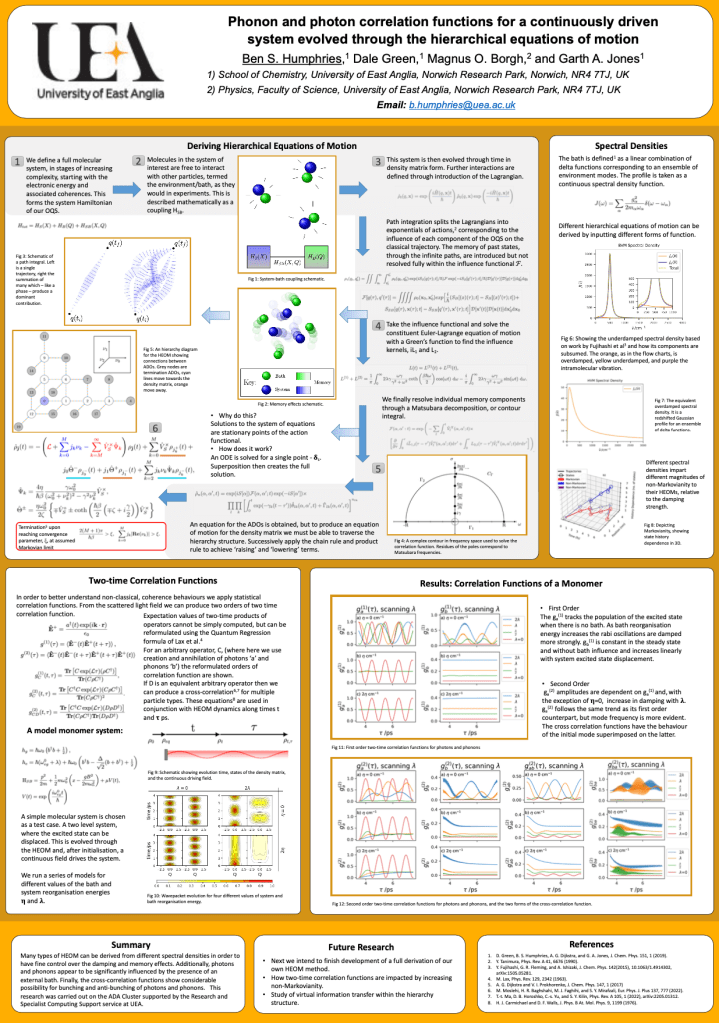
This poster was created for the UEA Chemistry Research Day 2022 and contains the latest results generated from the second-order two-time correlation function which we used to study the genuine quantum behaviour of photon anti-bunching. This work also contains a diagrammatic depiction of the derivation of an hierarchical equation of motion, something which I have been working on extensively, in order to make it relevant to a broader audience.
This poster was awarded runner-up Best Poster award.
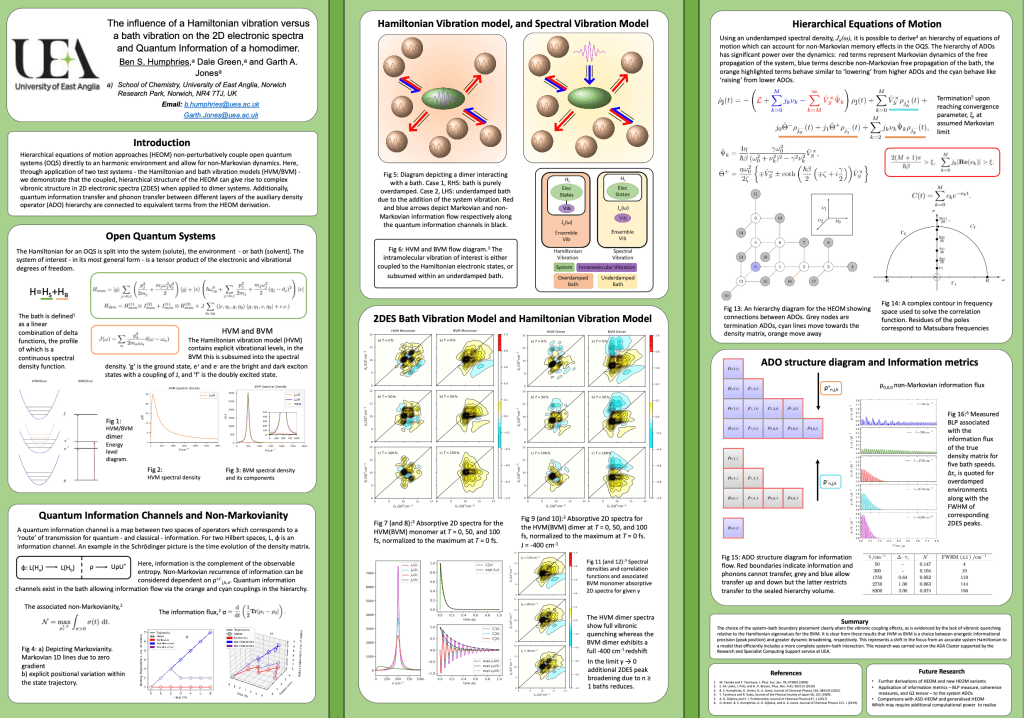
This is a poster I created for the 2022 RSC Spectroscopy and Dynamics Group conference which was held virtually on Gather Town. This poster contains finalised BVM and HVM figures which became part of the JCP 2022 studying the open quantum system-bath boundary placement. The final panel of this poster also introduces a newer type of hierarchy diagram which has been extended into my work on auxiliary density operators in 2023.
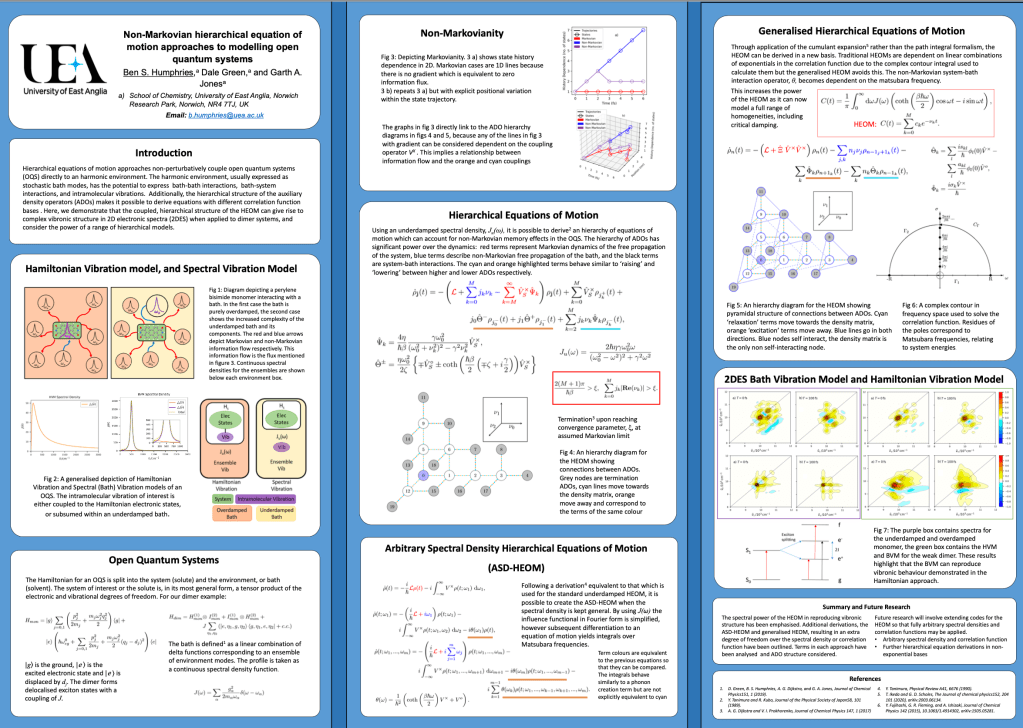
This poster was presented at the UEA Chemistry Research Day 2021 and contains the initial work on the Hamiltonian vibration and bath vibration models which I generated in my JCP 2022 publication. In addition this work contains a description of the Generalised HEOM.
This poster was awarded runner-up best poster award.
It is the role of current quantum optics to reveal and classify the nature of non-classical effects within electromagnetic fields. Many methods and metrics have been proposed for probing the quantum behaviour of light, ranging from Michelson type interferometry for photon detection,1 to the degree of coherence.2 In this work we consider first and second order correlation functions, g(1)/(2)(t),3 via the quantum regression formula of Lax et al.4 The system of interest considered is a molecule with electronic and vibrational degrees of freedom, coupled to an external heat bath, and it is evolved through the hierarchical equations of motion (HEOM),4 which we derive in detail. This talk is a continuation of work presented in the poster of the same name.
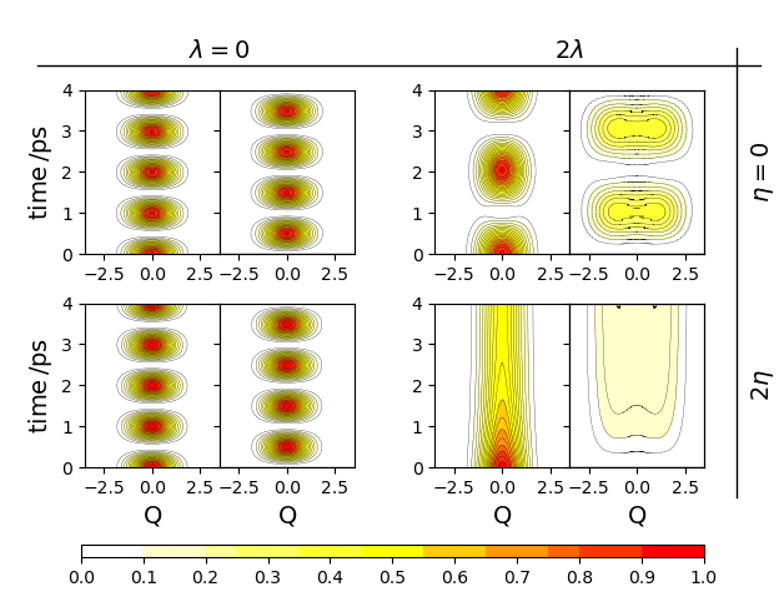
Figure 1. Wavepacket projection of the monomer ground and excited states when the system reorganisation energy is zero, and 2λ, and when the bath reorganisation energy is zero or 2η.
References
A. Yoshizawa, D. Fukuda, and H. Tsuchida, in 2013 Conf. Lasers Electro-Optics Pacific Rim (IEEE, 2013) pp. 1–2
J. K. Kalaga, W. Leonski, R. Szczsniak, and J. Perina, Entropy 24, 1 (2022)
H. J. Carmichael, Statistical Methods in Quantum Optics 1 (Springer Berlin Heidelberg, Berlin, Heidelberg, 1999) pp. 19–24.
M. Lax, Physical Review 129, 5, (1963), p. 2342-2348
Y. Tanimura and R. Kubo, J. Phys. Soc. Japan 58, 101 (1989)

 Ben S. Humphries